Read later guilt is real. Here's why it happens — and the only system that fixed mine.
84% of saved articles are never reopened. Your reading list isn't a failure of discipline — it's a failure of architecture.
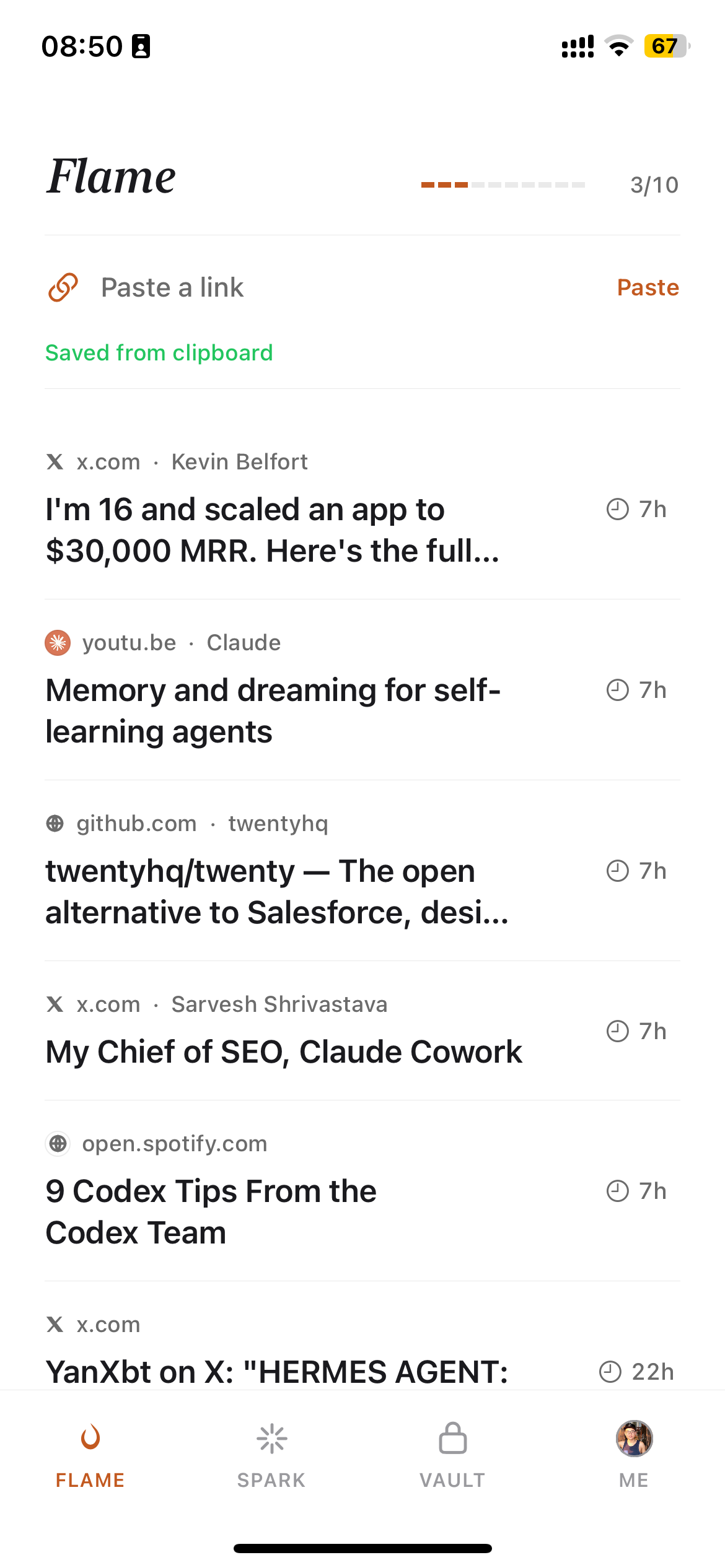
I had 4,083 articles saved across Pocket, Instapaper, Raindrop, two Notion databases, and a browser bookmarks folder called "actually read these." I read maybe 40 of them. Every time I opened any of these apps, I felt a specific kind of low-grade shame that I couldn't quite name.
Turns out it has a name. It's called read later guilt, and when Mozilla shut down Pocket in July 2025, the research I'd been ignoring became impossible to avoid: 84% of saves are never reopened— only 16% of bookmarks are ever revisited (Bergman, Whittaker & Schooler, 2021). I had 4,000 saved. We were all doing the same thing — treating the save button as a substitute for the reading we kept meaning to do.
"Every time I open Raindrop I feel a small wave of guilt and close it."
That's a real quote from a Hacker News thread on read-later apps, and it hit close enough that I screenshot it. The responses underneath were 180 people describing the same experience in different words:
- "My Instapaper queue goes back to 2013. I will never read those articles. I can't delete them either."
- "I stopped using Pocket because opening it felt like facing a to-do list I'd already failed."
- "Saving articles is how I tell myself I'm a curious person. Reading them would break the illusion."
- "3,200 saves. One a week if I'm lucky. Still saving."
This isn't a discipline problem. Every person in that thread was clearly disciplined in other areas of their life — they had jobs, shipped products, ran companies. The reading list guilt was a system problem wearing the mask of a character flaw.
Why saving feels like reading (but isn't)
The brain doesn't draw a hard line between intention and completion. When you hit save, you get a small dopamine hit — the article is handled, you've done something about it, closure reflex fires. The article goes into the queue and your brain moves on. Hours later, you don't remember the article; you remember that you dealt with it.
Cognitive scientists call incomplete tasks "open loops" — they occupy working memory even when you're not consciously thinking about them. A 2016 study in the Journal of Experimental Psychology found that unfinished tasks generate persistent background cognitive load — which means your 3,000-item reading queue is costing you attention even when you're not looking at it. The guilt isn't irrational. It's your brain correctly flagging that you made promises you're not keeping.
Why most read-later apps make the guilt worse
Read-later apps are, structurally, storage products with a reading skin. They make saving effortless — browser extension, share sheet, email forward — and reading effortful — open the app, scroll to find the article, find ten focused minutes. The product rewards the wrong action. I tested ten of them — Readwise, Matter, Mymind, Raindrop, Karakeep, Glasp, Recall, Instapaper, Mem, and Burn 451. Only one category actually reduces the queue instead of just reorganizing it.
Spaced repetition (Readwise) resurfaces old highlights — useful if you've already read and extracted from the article, useless for a queue of things you've never opened. Auto-organization (Mymind, Karakeep, Burn 451's vault) makes the pile searchable but doesn't shrink it. The only mechanism that actually eliminates reading list guilt is one that forces a real decision before the save can exist for more than a day.
The 24-hour deadline: uncomfortable, effective
Burn 451 works like this: save an article, you have 24 hours to read it before it's automatically deleted. You can rescue up to 10 articles per month into long-term storage — the cap is deliberate. Everything else burns.
The first week I used it, I saved 40% fewer articles than usual. Not because I was trying to save fewer — because the deadline made me honest. When I knew an article was going to disappear unless I read it today, most saves revealed themselves as performance: I was saving because saving signaled curiosity, not because I actually wanted to read. The queue dropped from 4,000 to under 20 within the first month.
The guilt went with it. There's nothing to feel bad about when the pile can't accumulate.
What about the articles you're afraid to lose?
Two options. First, the rescue mechanic: 10 articles per month that you explicitly pull from the burn queue go into long-term storage. If you can't fit your truly essential saves into 10 per month, the problem isn't the cap — it's that you haven't made the actual choice yet.
Second, the vault digest: Burn 451 can run AI summarization on articles before they burn, so you get the key takeaways from everything you saved even if you didn't read it in full. The digest goes into a searchable archive that your AI agent can query through the MCP server — so the information isn't lost, it's just processed differently. You traded an unread guilt pile for a structured knowledge base your tools can actually use. That's a better trade.
For your existing backlog — whatever's sitting in Instapaper, Raindrop, or your old Pocket export — the honest advice is: export the list, archive the file somewhere you'll never look, and delete the app. The articles from 2018 are not going to serve you. The person who saved them was interested in different things. The guilt of keeping them is higher than the cost of losing them.
More on that in the AI bookmark management explainer and the full FAQ.
Frequently asked questions
Is read later guilt a real psychological phenomenon?
Yes, and it has a documented mechanism. Cognitive scientists call it the 'Zeigarnik effect gone wrong': unfinished intentions generate persistent low-level cognitive load. Every unread article in your queue is a small open loop. At 50 saves it's background noise; at 2,000 it's a standing anxiety. The guilt specifically comes from the gap between the person you thought you'd be (curious, well-read, on top of things) and the person you actually are (busy, distracted, months behind). That gap is felt as moral failure even though it's just a bad system.
Why do I feel guilty about unread bookmarks even when I'm not looking at them?
Because the queue is a promise you made to yourself, and every day you don't read is another day you broke it. The brain registers outstanding self-commitments the same way it registers social promises — the failure to deliver lands as shame, not just inconvenience. Research on implementation intentions (Gollwitzer, 1999) shows that vague plans ('I'll read this later') create the same cognitive registration as concrete ones, which means you carry the guilt whether or not you remember the specific article.
What's the fastest way to eliminate reading list guilt right now?
Two options, depending on your psychology. Option one: delete everything saved more than 30 days ago without looking at it. If you haven't read it in a month, you won't. The guilt is worse than the loss. Option two: switch to a system with a forced expiry — like Burn 451's 24-hour deadline — so the pile can't accumulate going forward. For the existing backlog, a hard delete is usually faster than a systematic review. You're not losing information you'd have used; you're losing information you were performing intention about.
Does reading list guilt affect focus and productivity?
Yes, measurably. A 2016 study in the Journal of Experimental Psychology found that incomplete tasks occupy working memory even when not actively recalled — so your 3,000-item Pocket queue is costing you cognitive bandwidth you never consciously notice. The effect is strongest for people who treat saving as a productive act (rather than as deferral), because those people have the strongest self-expectation to eventually read. If you're a compulsive saver who feels guilty, that's not a personality flaw — it's the system working against you.
How is Burn 451 different from just using Pocket or Instapaper?
Pocket and Instapaper are libraries — infinitely patient, infinitely accumulating. Burn 451 is a 24-hour window: save an article, read it within a day, or it's gone. The architecture is different by design. You can't defer forever, which means you have to decide at save time whether the article is actually worth your attention. Most saves are not. Once you internalize that the burn is coming, you stop saving reflexively and start saving intentionally. The queue stays at 5–15 articles instead of 5,000. The guilt disappears because there's nothing to feel guilty about.
What happened to Pocket, and should I use a replacement?
Mozilla shut down Pocket in July 2025, refocusing on Firefox. Whatever the business reason, Pocket never solved the read-later guilt problem — it just made accumulation more frictionless. Controlled research on bookmark use found only 16% of saved bookmarks are ever revisited (Bergman, Whittaker & Schooler, 2021), and a save button with no expiry does nothing to change that. If you're looking for a replacement, the question isn't 'which app looks most like Pocket' — it's 'which app breaks the save-and-forget loop'. That's a different filter.
Can AI help with reading list guilt?
Partially. AI summarization (like Burn 451's vault digest) can compress a 3,000-word article into the three things you actually needed from it — which eliminates the read commitment without eliminating the value. That handles the backlog well. What AI can't do is fix the upstream behavior: if you keep saving 40 articles a day because it feels like being curious, the summarizer just moves the guilt from 'unread list' to 'unsummarized list'. The system fix is upstream: a hard limit on how long a save can live before it forces a decision.
I feel bad about my reading list but I'm also scared to delete it. What should I do?
Export it first. Pocket, Instapaper, and Raindrop all let you export to CSV or HTML. Put the file somewhere you'll never look. Then delete. The fear of deletion is almost always unfounded — in two years of asking people who deleted their queues, I've never met anyone who said 'I really needed that specific 2019 Medium article'. The reading list felt precious because it represented a version of you. The export lets you bury it without losing it. Then start fresh with a system that has a deadline.
The guilt disappears when the pile can't grow.
Burn 451 has a free tier. 24-hour deadline on every save. Pro adds an AI summary before it burns. MCP server so Claude can query your vault. iOS app, Chrome extension, web.
Try Burn 451 free