I save articles but never read them.
Maybe you do too. The honest math on why your read-later list is a graveyard, and the only fix that actually worked.
I have 4,083 saved articles. I've read maybe 40 of them all the way through. The rest sit in Pocket (now dead), Instapaper, Raindrop, three different Notion databases, my browser's bookmarks bar, and one Gmail label called "actually read this" with 612 emails in it.
Mozilla shut down Pocket in July 2025 and it forced me to face the number I'd been avoiding. The best controlled study of bookmark behavior found that only 16% of bookmarks are ever revisited — 84% are saved and never reopened(Bergman, Whittaker & Schooler, 2021). I'd been using a save button as a substitute for actually reading, and the pile had become a monument to all the curious people I was never going to be.
Why does saving feel like reading?
Because the brain doesn't draw a hard line between intention and action. A save triggers the same closure reflex as finishing a task — the article is handled, you've done something about it, you can move on. By the time you remember the pile exists, it's 800 items deep and has the energy of a graveyard. You don't visit graveyards for fun.
I read every read-later post-mortem on Hacker News for two months. The pattern is identical:
- "I have 3,200 articles in Pocket. I read maybe one a week. I keep saving anyway."
- "My Instapaper queue has articles from 2014 in it. I will never read them. I cannot bring myself to delete them."
- "Every time I open Raindrop I feel a small wave of guilt and close it."
- "The bookmarks aren't a reading list anymore. They're a personality."
Why do read-later apps make it worse?
Most read-later apps are storage products with a reading skin. They optimize for the wrong action. Saving is a one-tap browser extension; reading requires opening the app, finding the article, and committing ten focused minutes. The architecture rewards the wrong half of the loop. I tested ten of them — Readwise, Matter, Mymind, Raindrop, Karakeep, Glasp, Recall, Mem, Instapaper, and Burn 451 — and the only category that moves the needle is the one that refuses to let the pile grow.
What actually shrinks the graveyard?
Three approaches have been tried at scale, and only one works:
- Spaced repetition (Readwise): resurfaces old highlights in daily review. Great for snippets you've already extracted. Useless for full articles you haven't read once, because the read commitment is still ten minutes.
- Auto-organization (Mymind, Karakeep, Burn vault): AI-tags and clusters your saves so the pile is searchable. Makes the graveyard navigable; doesn't reduce it.
- Forced expiry (Burn 451): saves auto-delete in 24 hours unless you read or explicitly rescue them. The pile cannot grow. The graveyard cannot exist.
Option three is uncomfortable because it forces a real decision: is this article worth reading now, or am I just performing curiosity? If the answer is "later," it dies. If the answer is "now," you read it. The reading list stops being a wall of guilt and starts being a triage queue.
What if I want to keep some?
Burn 451 has a "rescue" mechanic — up to 10 articles per month can be pulled out of the burn queue and kept long-term. The cap is deliberate. If you can't fit your reading list into 10 must-keeps a month, the problem isn't the app, it's that you're saving as a substitute for choosing. The cap forces choosing.
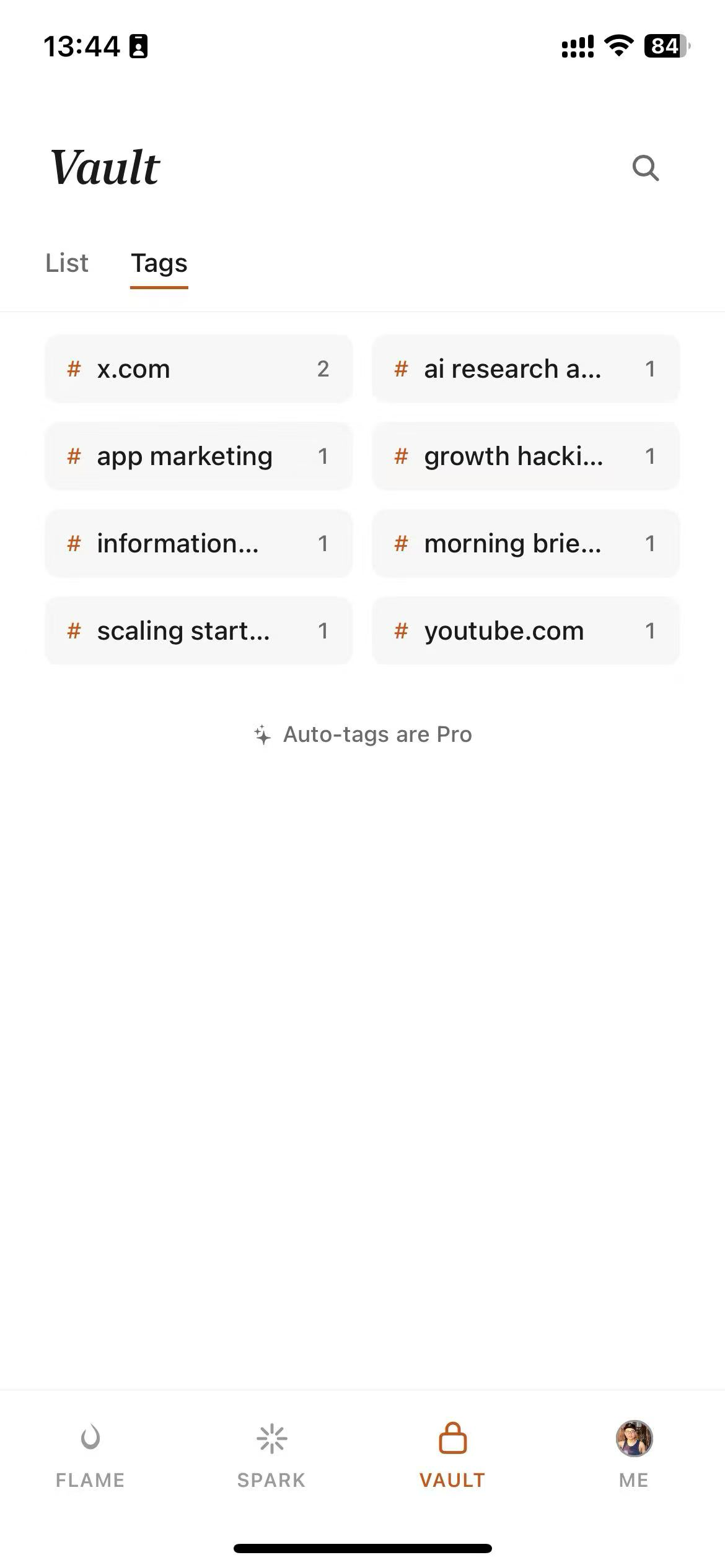
You can also feed the burn queue to the vault digest — AI reads and summarizes everything before it burns, so you get the gist of articles you'd otherwise have skimmed past. The graveyard doesn't go back into your reading pile; it goes into a search index your AI agent can query through the MCP server.
Frequently asked questions
Why do I save articles but never read them?
Saving feels like progress. Reading is work. The brain rewards the save with a tiny dopamine hit — you've 'done something' about the article — and then moves on. The article goes into a pile that gets larger every week, and once the pile passes ~50 items, it stops being a reading list and starts being a wall of guilt. Controlled research on bookmark behavior confirms the pattern, and every read-later post-mortem on Hacker News tells the same story.
What percentage of bookmarks actually get opened again?
Roughly 16%. In the largest controlled study of bookmark use, only 16% of saved bookmarks were ever revisited through the bookmark function — meaning 84% were saved and never returned to (Bergman, Whittaker & Schooler, Journal of Librarianship and Information Science, 2021). And of the few that were revisited, only 4% actually went through the bookmarks menu; the rest relied on an always-visible bar. Save-and-forget is the default, not the exception.
Is there an actual fix for the bookmark graveyard problem?
Three categories of fix have been tried. Spaced-repetition surfacing (Readwise) brings old saves back to your daily review — works for highlights, fails for full articles because the read commitment is too long. Auto-tag and search (Mymind, Karakeep, Burn 451 vault) makes the pile findable but doesn't reduce it. Forced expiry (Burn 451) is the only mechanism that actually shrinks the graveyard: bookmarks delete after 24 hours unless you read or rescue them, so the pile cannot grow. Pick the failure mode you can live with.
What should I do with the 4,000 articles I already have?
Don't try to read them. Three honest options: (1) export the list as a memento and accept that you've outgrown those interests, (2) run them through an AI summarizer like Burn 451's vault digest so you get the gist without the reading commitment, or (3) delete the bottom 80% by save date and only keep the most recent 800. The graveyard exists because you were optimistic about your future self. Your future self has a job and kids. Let it go.
Why do read-later apps make this worse instead of better?
Most read-later apps are storage products with a reading skin. They make saving frictionless (browser extensions, share sheets, email forwards) and reading effortful (open the app, find the article, focus for 10 minutes). The architecture rewards the wrong action. The only read-later apps that move the needle are ones that either force you to triage (Burn 451's 24-hour deadline) or remove the reading commitment entirely (AI summary tools).
Is read-later guilt a real thing?
It has its own subreddit (r/Pocket has hundreds of threads on it, r/productivity has more), and it shows up in Cal Newport's Deep Work, Tiago Forte's Building a Second Brain, and at least three peer-reviewed papers on information overload. The clinical term is 'productivity debt'. The honest term is: you treated saving as a moral substitute for reading, and now the unread pile feels like a personal failure. It's a real feeling. It's also fixable, but only by changing the system, not by trying harder.
Stop saving. Start reading.
Burn 451 has a free tier. 24-hour deadline on every save. Pro adds an AI summary before it burns. MCP server so Claude can read your saves. iOS app, Chrome extension, web.
Try Burn 451 free